retrieve profile profile retrieved
Open to remote GenAI architect roles & advisory
I architect LLM platforms, multi-agent systems and RAG, and take them into production.
10+ years in software and data engineering, 3.5+ years on generative and agentic AI. Contributor to LangChain and Pebblo. Maker of Outbound.
- years in software and data engineering
- 10+
- years on generative and agentic AI
- 3.5+
- merged PRs in LangChain projects and Pebblo
- 32
- merged PRs in Seagate CORTX
- 85
-
Pebblo's identity- and context-aware loaders, retrievers and agent tooling for LangChain and LlamaIndex, so sensitive data stays out of prompts and answers.
- LangChain
- LlamaIndex
- Pebblo
- Python
Problem
A RAG application copies documents into a vector store and, in doing so, forgets who was allowed to read them. Sensitive text then surfaces in answers to people who should never see it.
Teams needed that control inside the framework they already build with, not in a separate gateway they have to route around.
Architecture
- PebbloSafeLoader wraps any LangChain document loader. It reports what was loaded to the Pebblo server for classification, and carries each document's authorized identities into the vector store as metadata.
- Identity-aware SharePoint and Office 365 loaders read each file's permissions at load time.
- PebbloRetrievalQA filters retrieval by the caller's identity, then reports the prompt, the retrieved context and the response for audit.
- Matching components bring the same loading controls to LlamaIndex.
Trade-offs
- Enforce at retrieval, not at generation. Filtering on identity metadata in the vector store means unauthorized text never enters the prompt. The cost: it only works with stores that support metadata filters.
- Authorized identities are behind a feature flag in the SharePoint loader. Loads that do not need identity enforcement skip the extra permission calls.
Impact
- 14 merged pull requests in langchain-ai/langchain, 16 in daxa-ai/pebblo and 2 in langchain-google.
- The components ship inside langchain-community: PebbloSafeLoader, PebbloRetrievalQA, and identity support in the Google Drive, SharePoint and Office 365 loaders.
- Pebblo itself is open source and on PyPI, with 150 stars and 46 forks on GitHub.
- Daxa, the company behind Pebblo, has since been named in Gartner's 2025 Market Guide for AI Trust, Risk and Security Management.
-
An internal platform where engineering teams build and run AI agents without writing code, with RAG and tools over JIRA and CDET.
- RAG
- Agents
- JIRA
- CDET
Problem
Engineering teams wanted agents over their own data and tools, but every new agent meant a new codebase to build and maintain.
Architecture
- A no-code builder where a team defines an agent: its instructions, its knowledge sources and its tools.
- Retrieval-augmented generation over the content each agent is given.
- Tools are deployed with minimal code, with connectors to JIRA, the CDET defect tracker and web resources.
Trade-offs
- Knowledge is private to an agent; sharing is a choice. Each agent has its own knowledge, visible only to the person who built it. Sharing the agent with a team is opt-in and goes through the company's Microsoft identities, so nothing is exposed by default.
- Tools are chosen per agent, and guarded in code as well as in the prompt. The builder picks single tools or whole toolkits. A new tool is written, submitted to the repository, and then appears on the agent's create and edit page. Prompt guardrails and boundaries in code stop tools and agents from doing destructive work.
Impact
- Its first large use was a hackathon, where around 200 to 300 teams used it to compete.
-
vLLM and Text Embeddings Inference behind LiteLLM and an Nginx gateway: one OpenAI-compatible endpoint on GPUs you control.
- vLLM
- TEI
- LiteLLM
- Nginx
Problem
The company wanted LLM inference without sending its data to an outside provider.
So the models run inside the company, on a GPU it controls, behind one endpoint that existing OpenAI-style clients can call.
Architecture
- Nginx terminates TLS and is the single entry point.
- LiteLLM exposes one OpenAI-compatible API and routes each request to the right model server.
- vLLM serves the chat and completion models on GPU.
- Text Embeddings Inference serves the embedding models.
Trade-offs
- A gateway in front of the runtime: LiteLLM before vLLM. vLLM is a runtime built to get the most throughput from the GPU; LiteLLM is a gateway built to govern traffic. With several apps and models sharing one stack, the gateway is the single place to control access and routing. The cost: one more hop, and one more service to run.
Impact
- A trial deployment, stress-tested at 22 concurrent users, across embeddings and large-context inference, on a single 20 GB GPU.
-
Finds companies that fit a brief, screens and researches each one, finds a verified decision-maker and writes one short email and a LinkedIn message. A person approves the email before it becomes a draft in their own mailbox.
- LangGraph
- FastAPI
- PostgreSQL
- React
Problem
Outbound email is either generic or slow: someone has to find the right companies and research each one by hand before writing anything worth reading.
The engine does that work first and writes one short, personal email. It must never send without a person's approval, every paid lookup must be accounted for, and each customer's leads must stay invisible to every other customer.
Architecture
- Each campaign has a written brief of the ideal customer. Discovery asks several sources, the Y Combinator directory and web search among others, merges what they return and screens it against the brief. Only companies that fit become leads.
- A plain Python runner moves each lead through eight stages by status: intake, research, qualification, people, email address, copy, review, draft. The leads table is the queue: no Celery, no Redis. Every status change goes through a state machine and writes an event.
- LangGraph is used only where the work is graph-shaped, in research and in copywriting, as stateless subgraphs with no checkpointer.
- For qualification, a model judges each must-have, signal and rule-out in the brief, with its evidence. The score itself is computed in code, so it can be explained and repeated.
- Finding an email is a waterfall: first a shared directory of already verified addresses, then pay-as-you-go finders and verifiers. Every paid call passes through one meter: cache, budget guard, call, ledger row. The ledger is what charges a workspace's AI credits.
- Tenants are isolated by Postgres row-level security, the app connects as a least-privilege role, every API route declares its permission, and mailbox credentials are stored encrypted.
- An approved email is placed as a draft in the workspace's own Microsoft 365, Google or IMAP mailbox. Suppression and country rules are checked again on the server right before that, and opt-outs and hard bounces read from the inbox suppress the address automatically.
- One worker process serves every workspace, several workspaces and several leads at a time, behind a FastAPI service and a React app.
Trade-offs
- The table is the queue. Fewer moving parts to run and debug. The cost: the worker polls for due leads every two minutes instead of being pushed.
- LangGraph only inside two stages. The outer flow stays a readable state machine, where every status change writes an event. The cost: two styles of orchestration in one codebase.
- The model judges; code keeps the score. A model decides whether each criterion in the brief is met and cites its evidence, but the number comes from fixed weights in code. The cost: the criteria have to be written down before discovery is any good.
- A person approves before any draft. Slower than sending automatically, but nothing reaches a mailbox unreviewed. A workspace can let lower-scoring drafts through without review; that is off by default.
Impact
- Running as an invite-only alpha with four active users.
- An early-stage energy startup has about 35 email leads and more than 70 LinkedIn contacts from it.
- I run my own job search on it: more than 45 email leads and over 100 hot leads with LinkedIn contacts.
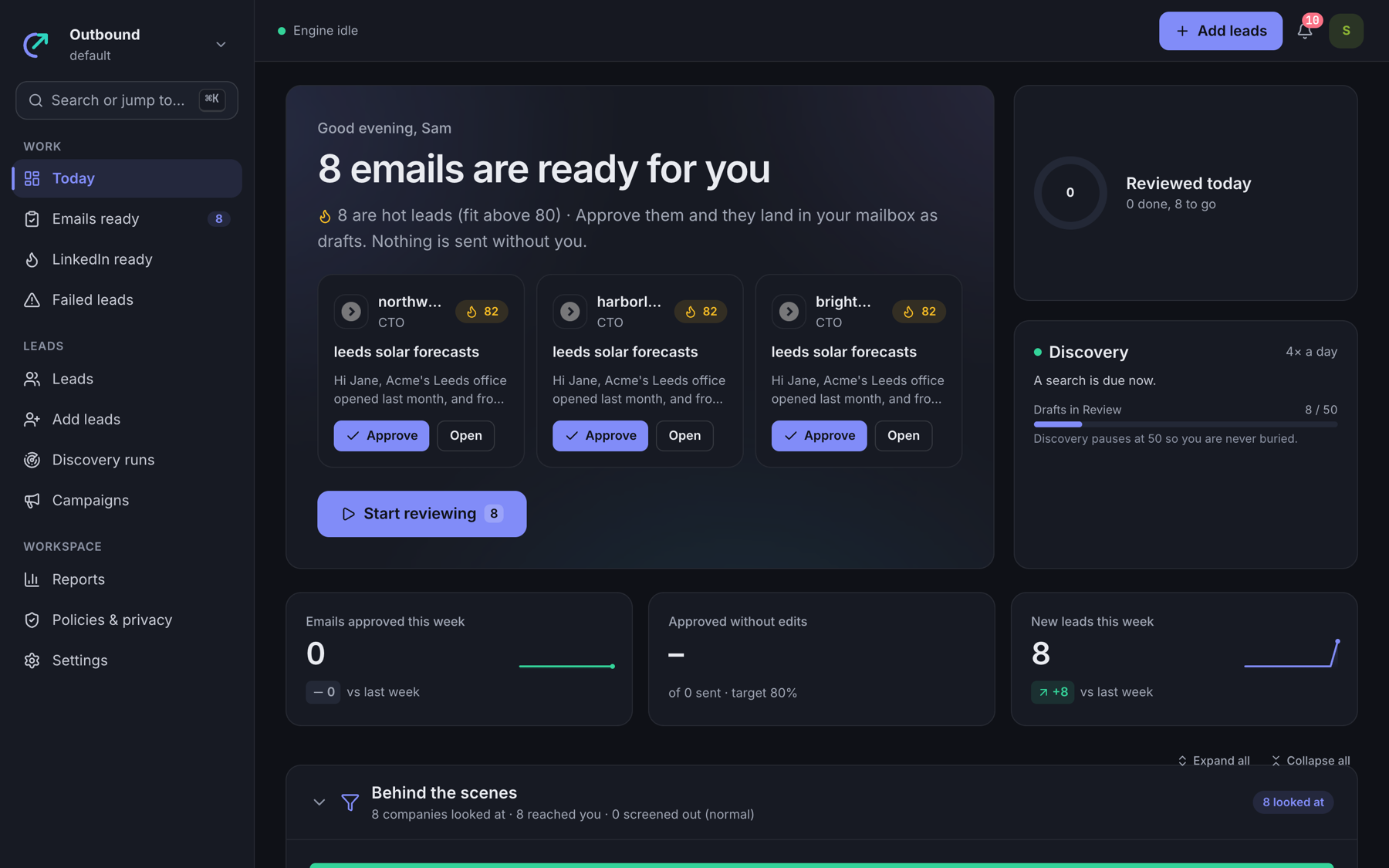
Today: what is ready to approve. Demo data. 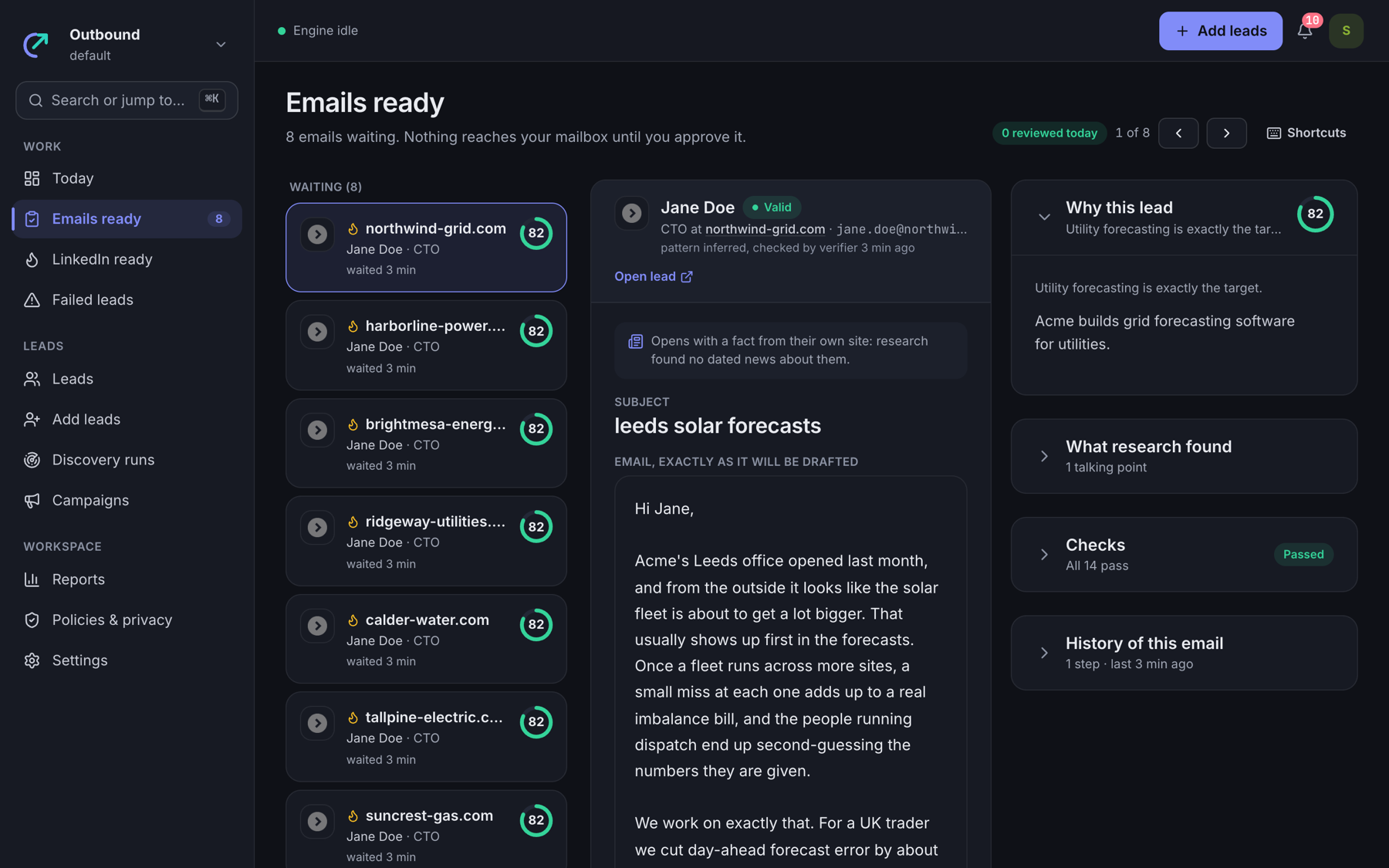
Review: the email, why the lead was chosen, and the checks it passed. 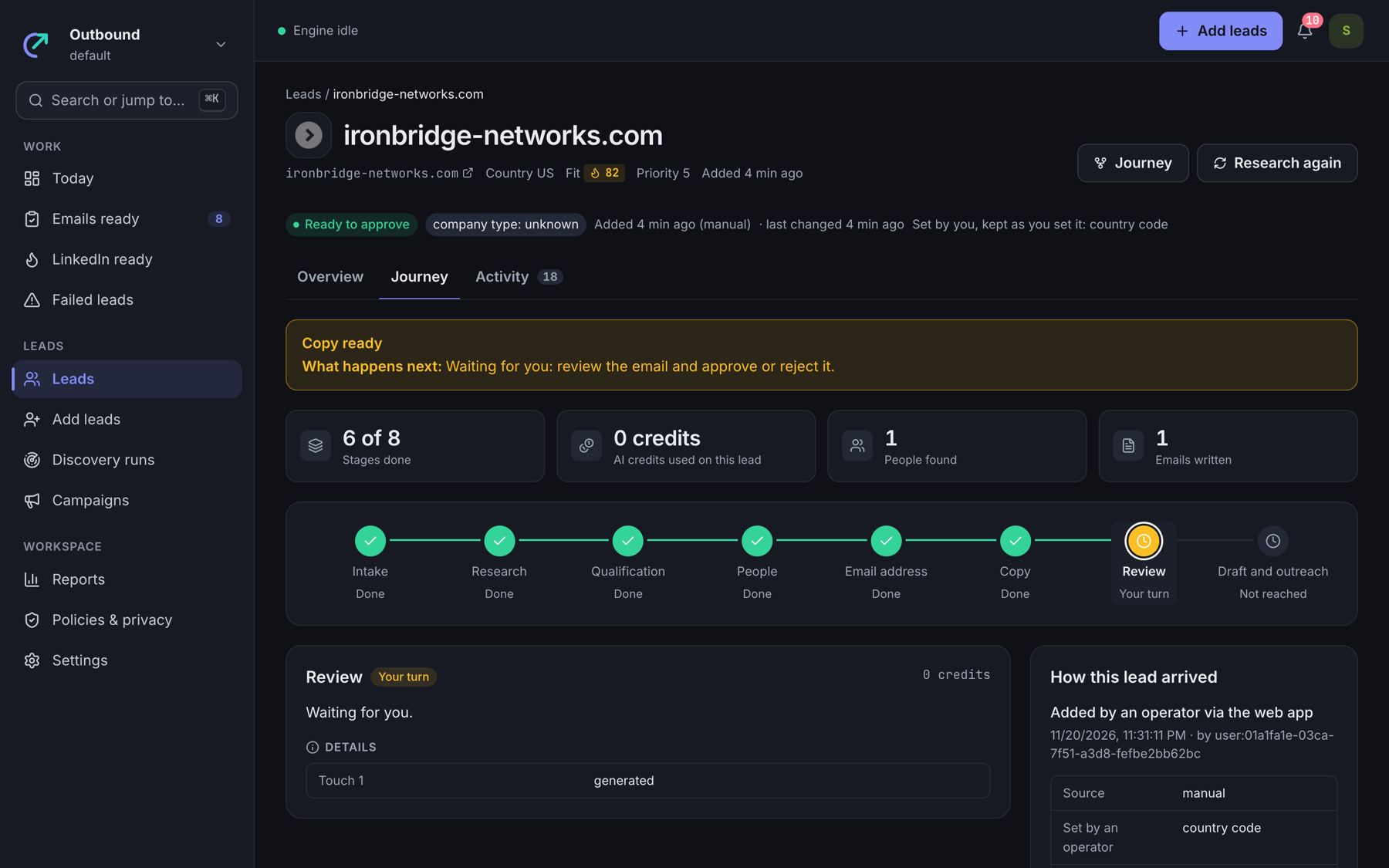
Journey: every stage a lead has been through.
Need a system like one of these designed or built? Tell me about it →
Also shipped
-
Smart Reporting Duke Energy
Natural-language questions over a database. Built the NL-to-SQL translation and its SQL-injection defences; taken from proof of concept to MVP.
-
DocBot Duke Energy
Agentic document RAG that answers from the latest version of a document, with session-scoped uploads and document-level access control.
-
Service Virtual Assistant Thermo Fisher Scientific
LLM chat for service technicians over product documentation and service tickets. Made resolutions 65% more efficient.
-
Tender and bid matching Thermo Fisher Scientific
Collects open tenders and matches each against the product catalogue with a standalone agent, returning a score and remarks.
Merged work you can read. Counts are merged pull requests on GitHub.
-
LangChain
Pebblo safe loader and retrieval QA; identity-aware SharePoint and Office 365 loaders.
14 merged PRs -
Pebblo
Daxa's data governance and security layer for GenAI applications.
16 merged PRs -
Seagate CORTX
Five repositories, 77 in cortx-utils: MessageBus, ConfStore and core utilities. From my earlier GitHub profile.
85 merged PRs -
langchain-google
LangChain's Google integrations.
2 merged PRs -
llmkit
My library: provider-agnostic LangChain helpers, switch models by config, opt-in Arize Phoenix tracing.
-
LlamaIndex
Pebblo components for secure data loading, built with Daxa.ai.
Agentic orchestration
Plan, call tools, keep state
- LangGraph
- LangChain
- LlamaIndex
- CrewAI
- DSPy
- MCP
Retrieval & data
Find the right context
- Qdrant
- Milvus
- pgvector
- PostgreSQL
- Supabase
Inference & serving
Run and expose models
- vLLM
- Ollama
- LiteLLM
- FastAPI
- Pydantic
Observability & evals
Know when it is wrong
- LangSmith
- Arize Phoenix
- RAG diagnostics
Infra & product
Ship it and keep it up
- Docker
- Kubernetes
- Terraform
- GCP
- Vercel
- React / Next.js
- Apr 2026 – Aug 2026 Duke Energy
Associate Manager, GenAI
Go Digital Technologies
- Owned NL-to-SQL for Smart Reporting, including its injection defences.
- Built DocBot, agentic RAG with document-level access control; took both from proof of concept to MVP.
- Apr 2025 – Nov 2025 Thermo Fisher Scientific
Senior GenAI Developer
Vaisesika
- Service Virtual Assistant for technicians: 65% more efficient resolutions.
- A standalone agent that scores open tenders against the product catalogue.
- Jan 2021 – Dec 2024, and Feb – Sep 2019 Cisco 2024 · Daxa.ai 2022–24 · Seagate 2021–22
GenAI Developer
Aziro (formerly MSys)
- A no-code agent platform with RAG and JIRA / CDET tools for Cisco.
- Pebblo components for LangChain and LlamaIndex with Daxa.ai, upstream and in the open.
- Core CORTX utilities for Seagate (MessageBus, ConfStore); Spark streaming pipelines on Databricks.
- Aug 2018 – Feb 2019 Kantar Media
Data Engineer
Cognizant
- Backend and report generation for a big-data audience-targeting product on Python and AWS.
- Mar 2015 – Aug 2018 Ericsson
ETL Developer
TCS
- Development, installation and upgrades for Eniq-Events, a telecom network management application.
Certifications
Education
- B.Tech, Electronics and Communication, PSIT Kanpur (UPTU), 2010 to 2014
Tell me what you are trying to build.
Remote architect roles in GenAI and agentic AI, or architecture reviews and advisory for your team. I reply by email.
- [email protected]
- Book a call calendar
- GitHub rahul-trip
- LinkedIn in/rahult18